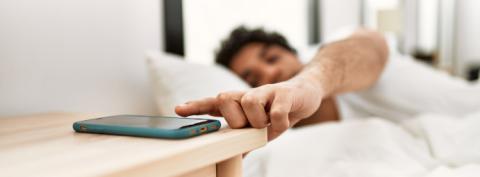
The bluish light of your mobile device is worts enemy of your sleep
The amount and quality of sleep are key in feeling rested. We are accustomed to having mobile devices with us virtually all day long. When it’s time to sleep, they should be well away from us, because they stop us from resting and make it more difficult to fall asleep.
Why do mobile devices influence our sleep?
Their bluish light interferes with the production of melatonin, which is the hormone that regulates the sleep-wakefulness cycle. That interference occurs through the photo-pigments present in some cells of the retina. If the sleep-wakefulness cycle is broken as a result of artificial light, we will find it much harder to fall asleep. Though we don’t realise it, electronic devices emit light which sends a message to our brain that it must be alert and not rest. So, when you go to bed, leave your electronic devices in a different room and, if possible, all of them together.
What can I do so that mobile devices do not interfere with my sleep?
- Do not check your email in bed. If you do, you are sending the wrong message to your brain, because it is activated as if it had to start working. To avoid that, relax. If it helps you, you can read or listen to the radio until you start falling asleep. In that way, your brain will get ready to rest.
- Do not leave your mobile phone on the bedside table. If you forget to put it on do not disturb mode, any notifications which come in while you are resting could startle you and interfere with your sleep. Sleeping with electronic devices is not beneficial in maintaining a good-quality rest. Experts recommend sleeping in a dark, well-ventilated room with no lights of any kind, because light, however minimum and dim, affects the quality of our sleep and rest.
- The light of the mobile phone or any other electronic device also interferes with the REM phase of sleep. If the production of melatonin is affected by the light, it is not released in enough quantities to induce sleep and it prevents you from reaching the REM phase, which is key in feeling rested the next day.
In order to protect yourself from light during the night, here are a some recommendations from Harvard University:
- Change the bluish light to warm light, which interferes less with the sleep-wakefulness cycle and does not play a part, or only a very subtle part, in the release of melatonin.
- Stop using electronic devices two or three hours before going to bed. In that way, your brain will get ready to rest.
- During the day, enjoy the light, the more the better. In that way, at night, when there is no natural light, your brain will notice and will increase your ability to sleep.
- If you have to work during the night, do not worry. There are filters that mitigate the effects of the bluish light, so that when you stop working and go to bed your body will adapt.
Remember that, for good-quality, reparative sleep, you should allow your body to follow its natural rhythms and do not interfere with the release of melatonin. The regulation of sleep is guided by the sunlight cycle. The body is activated and deactivated by the sunlight. If you are exposed to artificial light when you go to bed, your brain does not follow the instructions as necessary. So, when your body starts to go into “rest” mode, following the light patterns, set your electronic devices aside and go to bed.
- Log in to post comments